The 2026 Appliance Mandate: Navigating California’s New ‘Unit-in-a-Box’ Reality
As we navigate the midpoint of 2026, the landscape for Southern California property owners has shifted fundamentally. For decades, many landlords in markets like Los Angeles, Long Beach, and San Diego operated under a traditional model where appliances were often considered 'personal property' rather than a requirement for habitability. That era ended on January 1, 2026, with the full implementation of Assembly Bill 628 (AB 628).
Known colloquially among industry insiders as the 'Unit-in-a-Box' mandate, this law fundamentally redefined what constitutes a legal dwelling in California. It is no longer enough to provide four walls, running water, and heat. To be deemed legally 'habitable' under California Civil Code, every residential rental unit—including new leases and renewals—must now include a working stove and refrigerator. While seemingly straightforward, this shift presents a strategic crossroads for investors in Riverside, San Bernardino, and the Inland Empire. You can view this as a bureaucratic burden, or you can 'weaponize' these upgrades to protect your portfolio from the growing rental supply squeeze.
Defining the Statutory Minimum: What AB 628 Requires
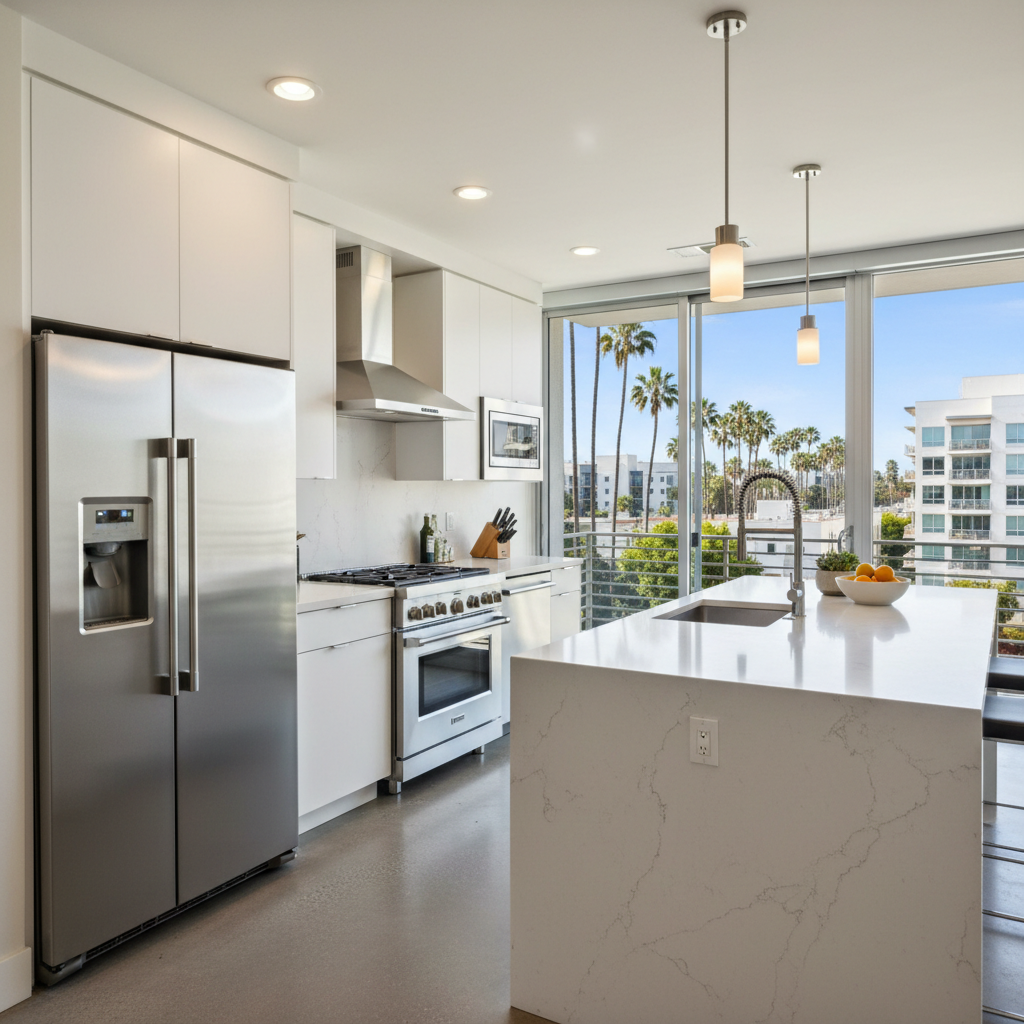
AB 628 stipulates that the absence of a functioning stove and refrigerator now constitutes a habitability violation, similar to a lack of electricity or a roof leak. This means that if an appliance fails and is not repaired within the statutory timeframe, a tenant may have the right to withhold rent or utilize 'repair and deduct' remedies. At McIntire Kingstone, we are advising our clients across Orange County and the South Bay that 'functional' is the keyword. A 20-year-old fridge that barely keeps milk cold may technically meet the letter of the law today, but it represents a massive liability tomorrow.
The Depreciation Dividend: Turning Mandatory Expenses into Tax-Deferred Growth
The immediate reaction to a new mandate is often to look at the cost. Equipping a 20-unit building in Los Angeles with mid-range stoves and refrigerators could easily cost upwards of $30,000. However, savvy investors understand the Depreciation Dividend. Because appliances are considered tangible personal property (not real property), they are eligible for unique tax treatments that can significantly soften the blow of this mandatory expense.
Direct Expensing and Bonus Depreciation
Under current federal tax guidelines, small to mid-sized property owners may be able to utilize Section 179 expensing or bonus depreciation to write off the full cost of these appliance upgrades in a single tax year. For a landlord in a high-tax bracket in San Diego or Orange County, this can result in a substantial reduction in taxable income. Instead of viewing the mandate as a 'loss,' it should be viewed as an acceleration of capital improvements that were likely inevitable, now subsidized by a reduction in your tax liability.
Coordinating with 1031 Exchanges and Refinancing
If you are currently in the process of a 1031 exchange or are looking to refinance a property in the Inland Empire to pull out equity, upgrading to a 'compliant' status is critical for appraisal value. Appraisers are increasingly looking at compliance with 2026 standards as a baseline for 'Class A' and 'Class B' designations. By installing energy-efficient, matching appliance packages now, you are ensuring your property maintains its peak valuation during the next market cycle.
Beyond White-and-Basic: Attracting the Long-Term Southern California Tenant
There is a temptation to fulfill the AB 628 mandate by purchasing the cheapest possible white appliances from a big-box retailer. In the competitive Southern California rental market, this is a missed opportunity. Markets like Santa Monica, Irvine, and Downtown Los Angeles are increasingly driven by a 'renter-by-choice' demographic that values aesthetics and sustainability.
Energy Efficiency as a Retention Tool
In regions like Riverside and San Bernardino, where utility costs skyrocket during the summer months due to air conditioning, energy-efficient appliances (Energy Star rated) serve as a major selling point. When you provide a modern, high-efficiency refrigerator, you are effectively putting money back into your tenant’s pocket every month through lower electricity bills. This reduces 'utility-based friction'—the phenomenon where a tenant moves because the total cost of living (rent + utilities) becomes unmanageable.
Standardization Across Your Portfolio
At McIntire Kingstone, we recommend that property owners standardize their appliance choices. If you own three four-plexes in Orange County, using the same make and model of stove across all units simplifies your maintenance supply chain. You can stock a single type of heating element or door seal, drastically reducing the time and cost spent on repairs. Furthermore, a consistent aesthetic across your units builds a professional brand, signalling to tenants that the property is managed by an attentive, high-level operator.
Risk Mitigation 101: Legal Protections and Lease Agreements
With the new mandate comes new risks. Since the law now mandates these appliances for habitability, you cannot simply waive your responsibility to repair them in the lease. However, you can—and should—implement robust maintenance schedules and clear tenant responsibilities to protect your investment.
Building Protection into the Lease
While you are responsible for the 'functioning' of the equipment, your lease agreement should clearly define what constitutes 'tenant-caused damage' versus 'normal wear and tear.' In Southern California, we often see issues with high-end appliances due to improper cleaning or overloading. We recommend including an Appliance Addendum that outlines:
- Required cleaning protocols (e.g., avoiding abrasive cleaners on stainless steel).
- Prohibitions on using the stove for auxiliary heating (a common cause of premature burner failure).
- A requirement for immediate reporting of any functional issues to prevent secondary damage (such as a fridge leak damaging the flooring).
The Preventative Maintenance Schedule
To comply with the 2026 laws, proactive management is key. We suggest a bi-annual check-up of all mandated appliances. This is not just a 'nice to have'; it is a legal defense. If a tenant claims a habitability violation due to a broken stove, having a documented history of preventative maintenance—vacuuming refrigerator coils, checking gas connections, and testing thermostat accuracy—proves that you have exercised due diligence as a landlord.
The Rental Supply Squeeze: Capitalizing on Market Non-Compliance
As noted by housing advocates and associations like AAGLA, California’s aggressive regulatory environment is unfortunately pushing many 'mom-and-pop' landlords to exit the market. Many property owners who have owned units in Los Angeles for 30 years are overwhelmed by the combination of AB 246 (eviction defense changes) and AB 628 (appliance mandates). This is leading to a significant number of 'naturally occurring' affordable units falling offline because the owners cannot or will not make the necessary upgrades to stay compliant.
Positioning Your Portfolio for Demand
This 'supply squeeze' creates a vacuum. As non-compliant units are pulled from the market or tied up in legal disputes, properties that are fully upgraded and compliant with 2026 standards will see a surge in demand. By proactively 'weaponizing' your habitability upgrades, you are positioning your portfolio as a safe, stable alternative for high-quality tenants fleeing poorly managed, non-compliant buildings.
Investors in the Inland Empire and San Diego who act now will benefit from higher occupancy rates and the ability to command premium rents. When a tenant sees a modern, compliant, and well-maintained kitchen, they aren't just seeing a stove and a fridge; they are seeing a landlord who invests in their property and follows the law. In 2026, that level of trust is the most valuable currency in the California real estate market.
Strategic Implementation: Your Next Steps
If you own rental property in Southern California, the time for 'wait-and-see' has passed. Compliance with AB 628 is not optional, but your strategy for achieving it is. McIntire Kingstone recommends a three-phased approach for our owners:
- Full Portfolio Audit: Identify every unit that currently lacks a landlord-provided stove or refrigerator. Assess the age and efficiency of current appliances in other units.
- Bulk Procurement: Work with a property management firm that has established relationships with appliance wholesalers to secure volume pricing. The cost savings on a 10-unit purchase often outweigh the cost of a few months of management fees.
- Update All Lease Documents: Ensure every lease signed or renewed in 2026 includes the necessary language to protect your appliance investment while acknowledging your duty to maintain habitability.
By transforming these statutory requirements into a comprehensive asset management strategy, you don't just survive the 2026 regulatory wave—you thrive on it. Don't let your units fall into the 'non-compliant' trap that is currently sidelining thousands of apartments across Los Angeles and Orange County. Upgrade, document, and dominate your local sub-market.